
Unibody Frame Straightening Los Angeles Drivers Trust
A hard curb strike, rear-end collision, or side impact can damage more than the panels you can see. Unibody frame straightening Los Angeles drivers need is about restoring the vehicle’s underlying structure so it can steer, align, protect occupants, and drive as intended. A bumper may look like the obvious problem, but the impact energy can travel through mounting points, rails, suspension areas, and the vehicle’s reinforced body structure.
That is why a proper collision inspection looks beyond dents and scratches. Before cosmetic repairs begin, the vehicle needs to be measured, evaluated, and repaired according to the damage it actually sustained. For drivers who rely on their car for work, family schedules, or daily commuting, getting that process right can prevent a visible repair from becoming an ongoing handling or tire-wear problem.
What Unibody Frame Straightening Actually Means
Most late-model cars, crossovers, SUVs, and many pickup trucks use a unibody design. Instead of having a separate body mounted to a heavy frame, the vehicle’s body and structural support system work together as one engineered unit. This design can improve weight efficiency, handling, and crash protection, but it also means structural damage must be addressed precisely.
Unibody straightening is the process of measuring and correcting areas that have shifted, bent, twisted, or compressed during an impact. Depending on the vehicle and collision, that can involve front or rear rails, apron panels, rocker areas, strut towers, floor sections, suspension mounting locations, or other structural points.
The goal is not to make damaged metal appear straight by eye. The goal is to bring key measurement points back within the manufacturer’s specifications where repairable. That distinction matters. A vehicle can look finished on the outside while still having alignment concerns, uneven tire wear, panel-fit issues, or compromised crash-energy management underneath.
Signs Your Vehicle May Need Structural Inspection
Not every accident requires frame or unibody correction. A low-speed parking-lot scrape may be limited to a bumper cover or door panel. However, the severity of visible damage does not always tell the full story. A seemingly modest impact can affect the structure if it lands in the wrong place or transfers force through a wheel, suspension component, or bumper reinforcement.
After a collision, watch for practical signs such as a steering wheel that no longer sits centered, pulling to one side, new vibration, uneven gaps around the hood or doors, or a trunk that will not latch or close smoothly. Tires that wear unusually quickly after an accident can also point to alignment or suspension concerns.
Warning lights, changes in ride height, rubbing noises, and difficulty opening or closing panels deserve attention as well. These symptoms do not automatically mean the unibody is damaged. They do mean the vehicle should be inspected instead of judged only by what is visible in the driveway.
Why Unibody Frame Straightening in Los Angeles Can Be More Complex
Los Angeles traffic creates a broad range of collision scenarios. Stop-and-go freeway impacts can compress front or rear structures. Tight parking lots and crowded neighborhood streets create corner impacts that affect bumper reinforcements, fenders, wheel openings, and suspension areas. Road debris, potholes, curb strikes, and rideshare mileage can add complications after the original incident.
Vehicle design also affects the repair plan. Modern vehicles may place sensors, cameras, radar components, wiring, active safety systems, and airbags near areas affected by a collision. A structural repair may need to be coordinated with mechanical work, wheel alignment, auto glass service, sensor calibration, paint work, and final safety-system checks.
It depends on the damage. Some vehicles need limited correction and alignment verification. Others require a more involved repair plan, parts replacement, and multiple inspections before they are ready to return to the road.
The Unibody Repair Process Should Start With Measurement
A reliable repair process is controlled, documented, and based on the vehicle’s actual condition. At Onyx Auto Body, collision repair planning begins by identifying both visible damage and the issues that may be hidden behind panels, bumpers, or underbody covers.
Initial damage evaluation
The first step is a thorough inspection. Technicians assess the impact area, review panel gaps and mounting points, examine suspension and steering components when needed, and look for signs that the collision affected surrounding structural areas. Photos and documentation help support the repair plan and can also be useful when working through an insurance claim.
Some damage is only confirmed after disassembly. A bumper cover can conceal damage to absorbers, reinforcement bars, brackets, cooling components, wiring, or structural mounting areas. This is one reason an early estimate may change once the vehicle is opened up for a complete assessment.
Electronic measuring and repair planning
Structural measurements compare critical points on the vehicle against factory specifications. This provides a factual starting point for repair decisions. It helps distinguish a cosmetic panel concern from a structural condition that needs correction.
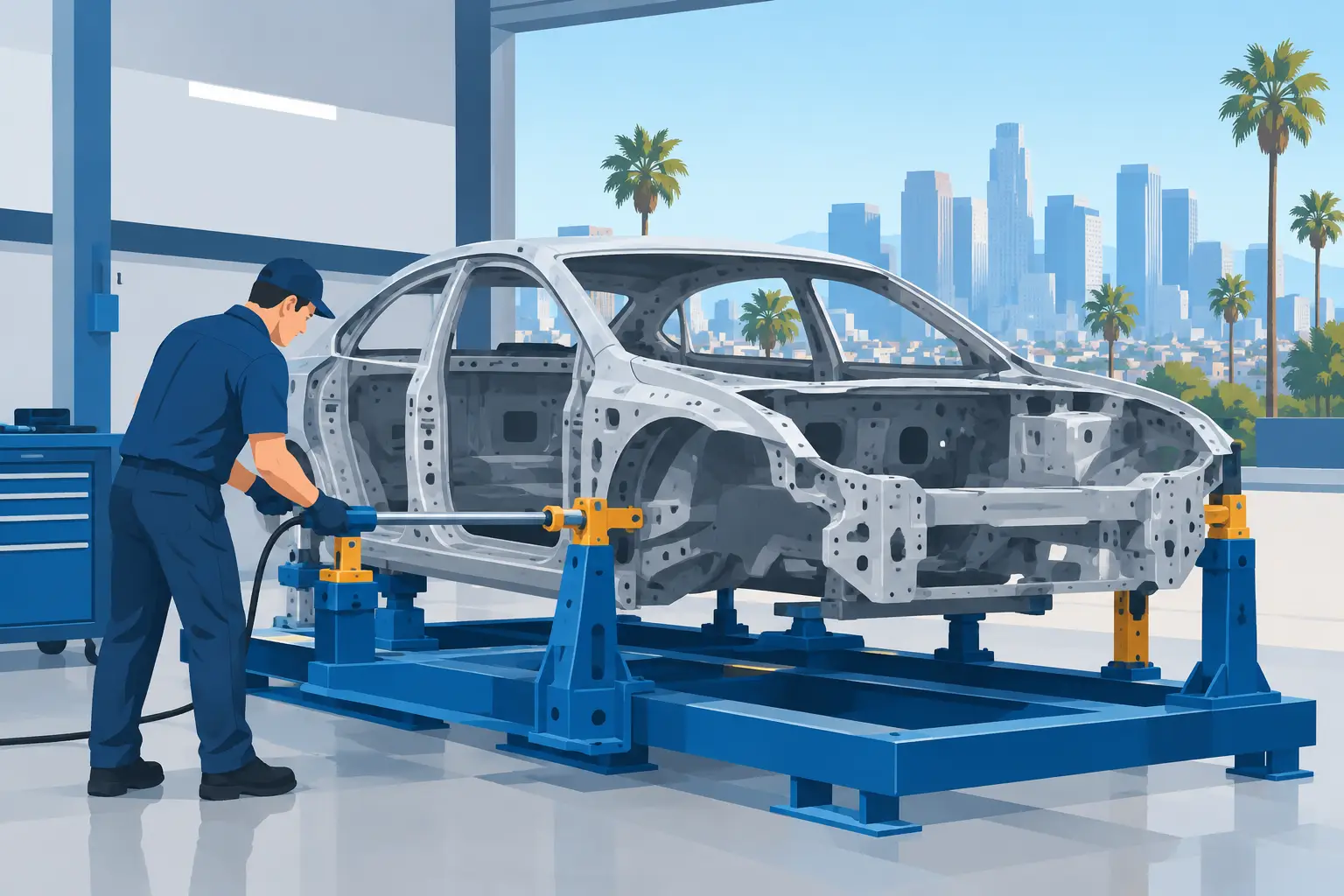
If straightening is appropriate, the vehicle is secured on specialized equipment and controlled force is applied to bring affected areas back toward specification. The process is deliberate. Pulling too far, working from the wrong point, or skipping measurement checks can create new problems instead of resolving the original damage.
In some cases, replacement is safer or more appropriate than attempting to straighten a particular part. High-strength steels, aluminum components, corrosion protection requirements, and manufacturer repair procedures all influence that decision. The right repair is based on the vehicle, the impact, and repairability, not on choosing the quickest-looking option.
Coordinating mechanical and cosmetic repairs
Once structural conditions are addressed, related repairs can move forward. That may include suspension or steering repairs, wheel alignment, bumper and body-panel work, paint matching, windshield or auto glass replacement, and replacement of damaged trim or lighting components.
This coordinated approach matters because each system affects the finished result. A beautifully painted fender will not solve a wheel alignment issue. Likewise, a corrected structural point may still require panel fitting and paint work to restore the vehicle’s appearance and weather sealing.
Final quality checks
Before pickup, the repair should be reviewed for fit, finish, function, and drivability. Final checks can include panel alignment, latch operation, lights, warning indicators, wheel alignment results, road-test considerations when appropriate, and confirmation that related systems have been addressed.
The exact checklist varies by repair. What should not vary is the expectation that the vehicle is inspected as a complete vehicle, not treated as a collection of separate cosmetic tasks.
Insurance Documentation and Repair Decisions
After an accident, insurance questions can add pressure to an already inconvenient situation. Structural damage often involves supplements because the full extent may not be visible until teardown and measurement are complete. That is normal in collision repair, particularly after impacts involving bumpers, wheels, or multiple body panels.
Clear documentation helps explain why additional work is needed. Photos, measurements, repair procedures, and parts information support communication with the insurer while keeping the repair plan focused on the vehicle’s condition. Drivers should also keep their claim number, insurer contact details, and any accident photos available when possible.
You do not need to become a collision expert to move the process forward. A shop that helps organize documentation, communicates repair updates, and explains changes in plain language can make the process far easier to manage.
Choosing a Shop for Structural Repair
For unibody work, ask whether the shop performs structural measurement, handles related mechanical and body repairs, and follows a documented quality-control process. It is also reasonable to ask how hidden damage is handled, how repair updates are communicated, and whether the shop can coordinate towing if the vehicle is not safe to drive.
Convenience matters, especially after a crash, but structural repair is not the place to rely on a quick visual assessment alone. The best path is a complete evaluation followed by a repair plan that accounts for safety, alignment, appearance, and daily reliability.
If your vehicle was involved in a meaningful impact, avoid assuming it is safe simply because it still starts and moves. Arrange an inspection, keep your accident information handy, and let the repair plan be guided by measurements and evidence. That is the practical first step toward getting back on Los Angeles roads with more confidence.
Comments